|
The Original Boar |
|||
|
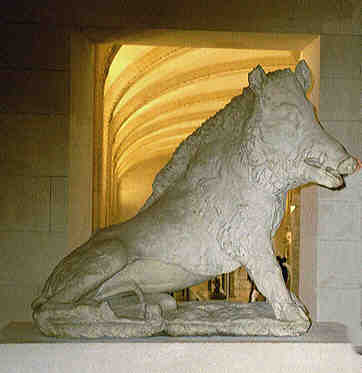
Right: is a marble copy of the Florentine Boar which now resides at the Louvre. This probably looks more like the Arboretum's Boar than Tacca's Boar (below). The original boar was carved from marble during the centuries BC by a Greek sculptor. This sculpture was either lost or destroyed.During the 17th century the Italians made a marble copy 'Cinghiale' housed in the Uffizi Gallery in Florence. It has been suggested the original ancient Greek marble Boar was thought to be a part of a larger group representing a hunting scene, where he was just awakening having been disturbed by the hunt. |
|
||
|
|
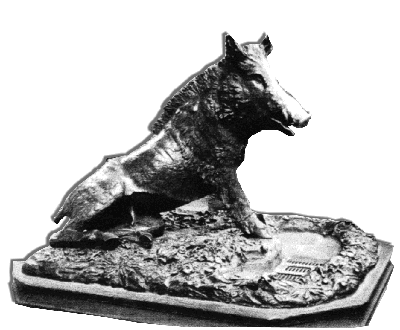
Tacca's original bronze
(fountain),
circa 1612
Pietro Tacca (sculptor, 1577-1640)
|
||
Thousands of visitors have rubbed this Boar's nose for good luck over the centuries, causing damage, so the statue was recently replaced by an identical copy click here for full story. |
Free JavaScripts provided by The JavaScript Source |
||
|
A Bronze casting was made by Pietro Tacca in 1612 who changed the base of the simple Greek statue by adding a pool surrounded by plants, snakes, frogs and turtles, this now sits in the Marketo Nuovo (New Market) in Florence. This is a fountain with water exiting through the boar's mouth, visitors place coins in his mouth, which fall out into the drain grate, and make a wish. Known locally as "Il Porcellino" (The little pig) his nose is shiny through centuries of being rubbed by visitors for good luck. Later in 1857, Brunelli cast his version, which sits in the Straw Market in Florence. The Arboretum Boar was sculpted by William John Coffee in 1806 from drawings of Tacca's 1612 version. In 1962, five copies of Tacca's sculpture were cast by the Florence foundry, Fonderia Ferdinando Marinelli, for public display.The Florentine Boar remains one of Europe's significant art works, copies of which can be found around the world. One of these was donated to the University of Waterloo (Canada) in 1978 and the other four copies of the boar are located in Sydney, Australia; California; Florence; and in Butchart Gardens, Victoria, B.C Copies, from miniatures to full size, may be purchased from The Galleria Frilli Via dei Fossi 29, 50123 Firenze, Italy, it is possible that thousands of copies of this boar, in varying sizes, exist in private collections throughout the world. |
|||
| Here
are some links to a small selection of the available websites giving
information about boar statues around the world:
Further reading and research Munich Cotswold Ironworks Antwerp Lyndonville, Vermont Vancouver Island Laeken New York USA Waterloo, Canada (Celebrating the Boar) Victoria, British Columbia, Canada Butchart Gardens, Vermont Philatelic Society (A fascinating website offering a detailed history of the boar in history and culture, including details of Tacca's recasting of the Greco-Roman Cinghiale, The Floerentine Boar) |
|||
|
The Boar in Celtic and Welsh Mythology |
|||
| Animals
in Celtic and Welsh mythology are tied in with fertility and vitality,
because they are living, moving, and growing. They also provide vitality
and continued life for the tribes through their meat, skins, and bones.
In addition, they are a connection to the realm of spirits and the gods.
In addition
to representing fertility and wealth, boars symbolise courage and strong
warriors for they are strong, dangerous, and very hard to kill. Their
appearance in dreams and visions also indicates warriors. Statues
of boars are occasionally found in the company of statues of armed
warriors, further indicating an association between boars and warriors. |
|||