|
Tree Management and the Refurbishment Programme |
||
| John Claudius
Loudon's original plan for the Arboretum was unfortunately lost due to unforeseen
circumstances, when localised industrial pollution killed off many of
the trees during the late 19th century. Many
new trees, with a much higher resistance to pollution, were
introduced. These trees included mostly London Plane, and a number
of Lime Trees.
Loudon stated that "It forms no part of the design of this Arboretum to exhibit large trees, more especially of the common kinds; and whenever any one of these, or, indeed, any tree whatever in the Arboretum, reaches a height of 40 or 50 feet, it should be removed. That height is quite sufficient for producing shade, and showing the form and character of the tree, and its flowers and fruit; and nothing more is required, or can be admitted in an arboretum on so limited a piece of ground. If this part of the management laid down be neglected, the rapid-growing large trees will over top the slow growing smaller ones and the shrubs and ultimately destroy all the finer kinds" (J. C. Loudon 1840).
The current plan is to plant over a hundred new trees in the Arboretum, with the inclusion of some of Loudon's original species. Also in keeping with the original plan, a number of new species will be introduced, as J. C. Loudon had intended that new species should be introduced from time to time, as and when they were discovered. The first stage of of this plan will begin with the removal of 109 trees, mostly London Plane and some Limes, (there are about 600 trees in the Arboretum) to make room for the new plantings (a selection of 156 new trees, reflecting Loudon and Strutt's original collection are to be planted). Most of the trees that are due to be removed are either damaged, dying, over mature or are crowding some of the more important trees which will die otherwise. |
||
|
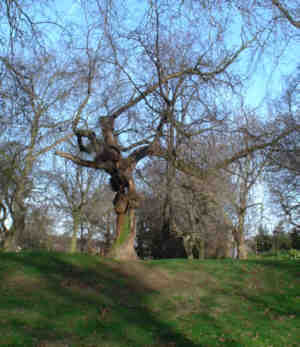
Mulberry Tree |
||
|
 |
|
This Mulberry tree has sustained significant damage over the years, including being topped due to being crowded by a neighbouring Plane tree. In view of its age and the importance of being one of the original Loudon trees, every effort is to be made to preserve the tree and encourage new growth. |
||
|
Monday March 10th 2003 |
||
|
Photos Christopher Harris, March 2003 |
||
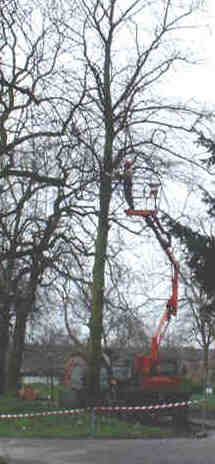 |
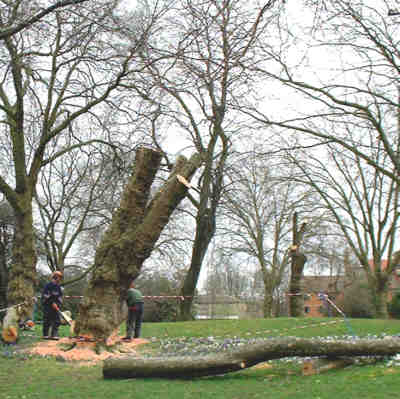
Left: A hydraulic lift is used to help remove the higher branches before felling a tree. Below: A plane tree trunk is felled ready for removal.
|
|
|
|
||
|
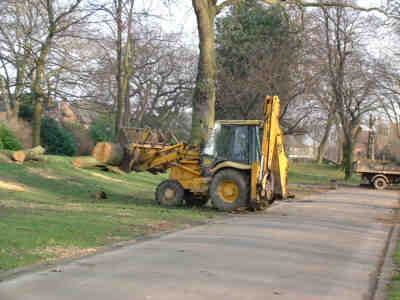
Right: A trunk is cut into sections before being removed with the help of a JCB |
|
|
|
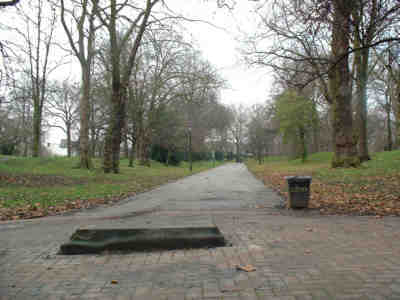
March 19th 2003 The tree felling and clearing is now complete Looking North from the Boar Plinth December 2002 and March 2003 |
||
Move your mouse over this photo, taken on December 5th 2002 to compare the scene before and after tree removal, with a photo taken on March 19th 2003. It is obvious that the impact of tree removal has not been as great as one may expect. Photo C. Harris December 2002/March 2003 |
|
|
|
Fountain Walk December 2002 and March 2003 |
||
| Move your mouse pointer over this photo, taken in December 2002 to compare this view of the Grove Street end of the Fountain Walk with the same viewpoint on March 19th 2003 | 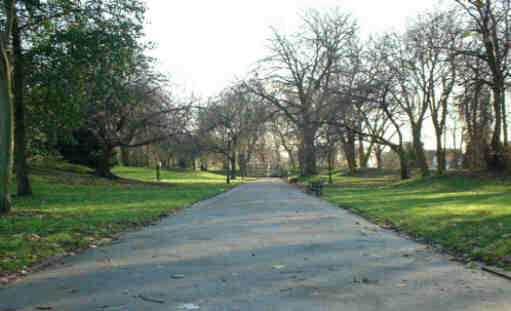 |
|
|
Tree and Shrub Planting |
||
| English Landscapes have
been contracted to plant the trees and shrubs. We are now seeing the
return of some of the original species, including varieties of Robina,
Ash, Wing Nuts and Magnolia.
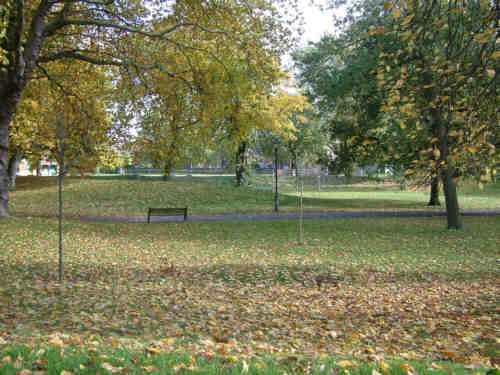
Photos Christopher Harris - November 19th 2004 |
 |
|
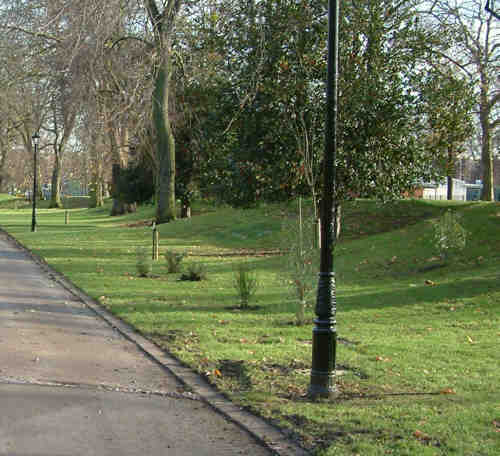
| Right: Shrubs planted along the main Broadwalk |
|
|
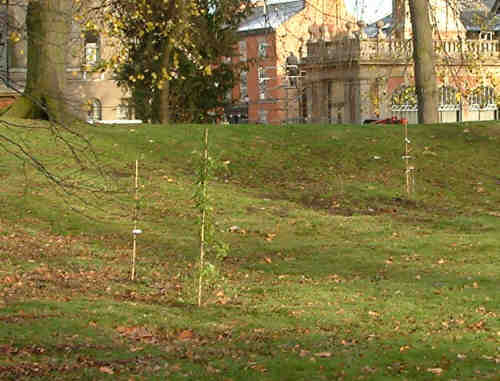
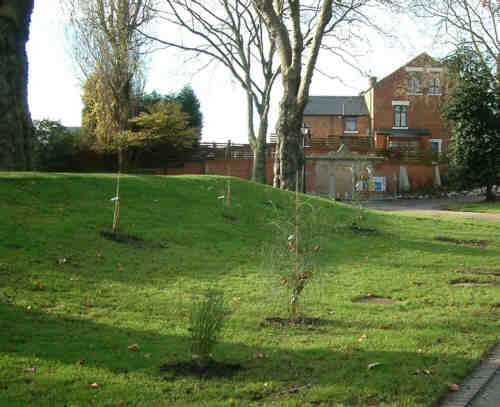
| Right: The mounds
are being planted out with shrubs. This will enhance the beauty of the
Arboretum and restore much of what has been lost over the past century.
Photos Christopher Harris - November 19th 2004 |
|
|
|
Over 1,000 shrubs have now been planted, including many along the central pathways. |
||
|
Right: Trees and Shrubs Planted on the opposite side of the Broadwalk Photos Christopher Harris - November 19th 2004 |
|
|